Grounded: A Climate Justice Story
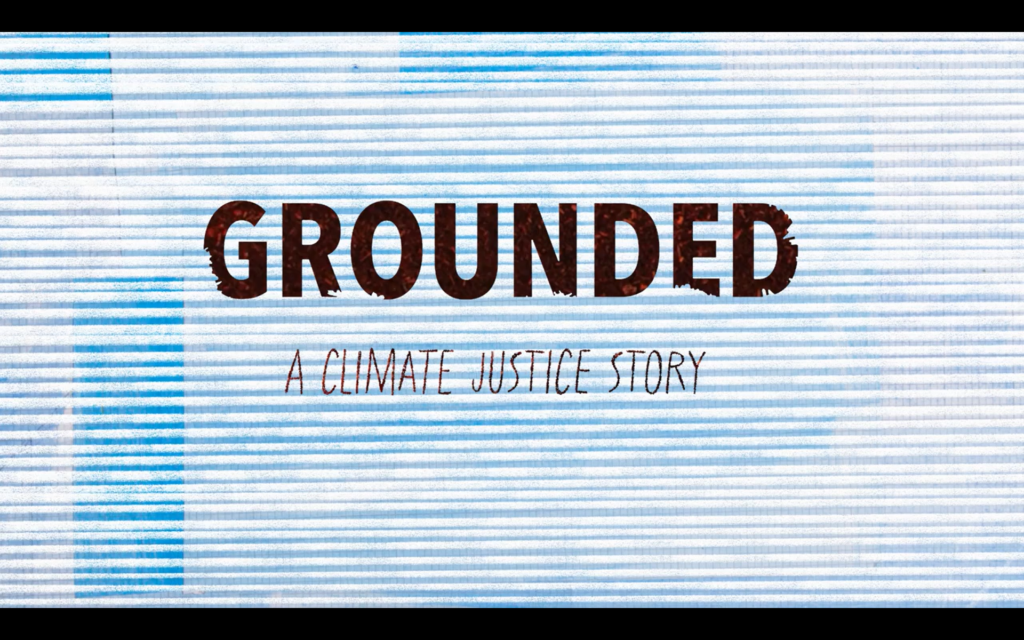
Grounded is a short animated film that explores climate justice not as an abstract concept, but as something lived, uneven, and deeply political.
Rather than approaching climate change purely through technical solutions or policy targets, the film reflects on the social and ethical dimensions of the climate crisis — asking whose lives, livelihoods, and futures are most affected, and how questions of inequality, responsibility, and care shape the way climate action unfolds.
The film emerged from a series of interdisciplinary conversations and workshops that brought together researchers, practitioners, and artists to reflect on climate crisis, inequality, and collective responsibility. Through animation and storytelling, Grounded translates these discussions into a short visual narrative that invites viewers to pause and reflect on the tensions that shape contemporary climate action.
The film was developed through RECAST: Reframing Climate Action as Social Justice, an interdisciplinary project led by DECOLAB at the Bartlett School of Architecture, in collaboration with the UCL Institute for Global Health, and funded by UCL’s Grand Challenge of Climate Crisis.
Watch the Film
Film Launch Event
Grounded was officially launched at UCL East, Cinema Auditorium (One Pool Street, London) on 11 March 2026, as part of UCL’s 28 Days of Sustainability.
The event brought together a screening of the film followed by a curated conversation reflecting on the process behind the project — including how collective discussions on climate crisis and justice were translated into visual storytelling, what complexities are simplified in that process, and whose voices often remain marginal.
The discussion featured contributors involved in the RECAST workshops and the filmmaking process, along with audience reflections on how climate justice might be understood and communicated differently.
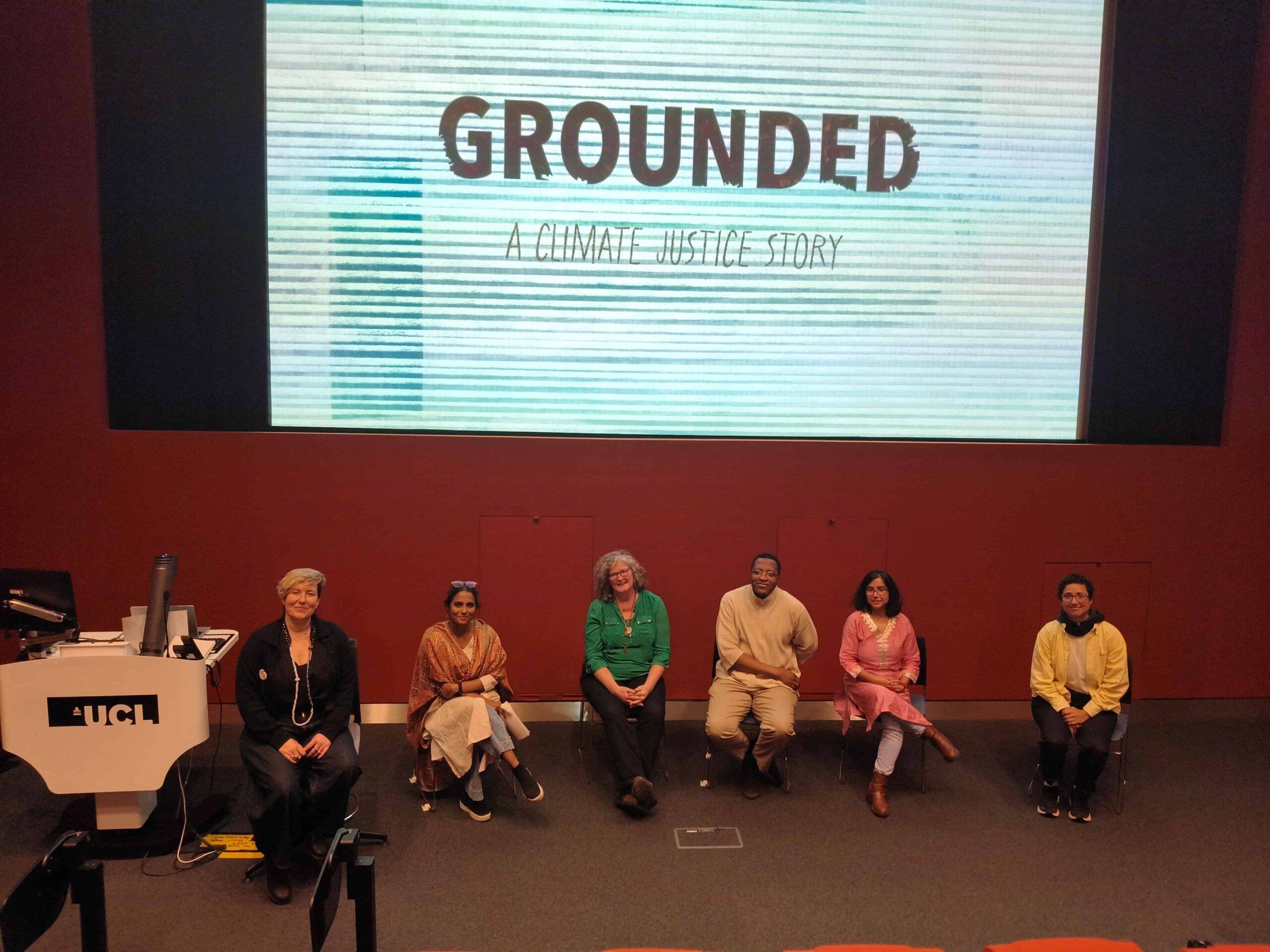
Speakers at the Launch Event
Bipashyee Ghosh, is a Lecturer in Engineering, Innovation and Public Policy at UCL Department of Science, Technology, Engineering and Public Policy (STEaPP).
Her research is on Innovation, Policy and Sustainability transitions. She has worked in research projects on Transformative Innovation Policy and Deep Transitions, focussing on innovation and knowledge creation towards sustainable, democratic and decolonial futures.
Blanche Cameron, is an Associate Professor at the Bartlett School of Architecture at She is an ecological designer, builder and teacher, working at UCL and with community groups, local authorities, businesses and others on practical solutions to global health, biodiversity and climate challenges and associated social, environmental and economic injustices. She an active member of ACAN, the Architects Climate Action Network, help mentor the Bartlett School of Architecture Society and supported BSA to declare a climate and ecological emergency in 2019.
Lakshmi Priya Rajendran is an Associate Professor at the Bartlett School of Architecture, University College London. Her work sits at the intersection of architecture, urban studies, and storytelling, focusing on public space, spatial justice, and everyday life in cities of the Global South. She is the Director of DECOLAB, a collaborative platform exploring creative and decolonial approaches to research, pedagogy, and practice in the built environment.
Ludovica Fales (Panel Chair), is a Lecturer in Experimental and Interactive Storytelling at UCL. An award-winning filmmaker and artist, she works at the intersection of film, emerging technologies, and expanded cinema. Through participatory and contemporary narrative forms, her practice explores questions of subjectivity, memory, and political imagination. Her films Letters from Palestine (2010), The Real Social Network (2012), Fear and Desire (2015), The Tales of the Black Saint (2021), and Lala (2023) have won multiple awards and screened at major international festivals.
Maxwell Mutanda is a Lecturer in Environmental and Spatial Equity at the Bartlett School of Architecture, UCL. He is a pluridisciplinary researcher and visual artist whose work across data visualisation and architectural practice investigates the role of globalisation, climate, and technology within the built environment.
Temujen Gunawardena is an Artist and Filmmaker based in the UK. For the past 15 years she led pioneering education projects and partnered with hundreds of organisations to use visual storytelling as a tool for clarity, creativity, and meaningful engagement. Her roots in both the UK and Sri Lanka connect me to different worlds, enriching my creative work and curiosity to work across cultural and social divides to find common language.