UNTO Podcast
Welcome to UNTO : Unlearning Together, a new podcast series from Decolab!
UNTO, is all about questioning and expanding how we think about knowledge creation. We’ll be diving into the ways research, practice, and pedagogy shape our understanding of what it means to build equitable and just futures. Each episode, we’re joined by incredible guests who bring fresh insights from decolonial perspectives, challenging traditional narratives in academia and beyond.
Join us as we explore topics like ethics, knowledge justice, alternative epistemologies, and the role of education in fostering a more inclusive understanding of the world. With each episode, UNTO will provide insights from researchers and practitioners who are actively unlearning conventional methods and building transformative narratives.
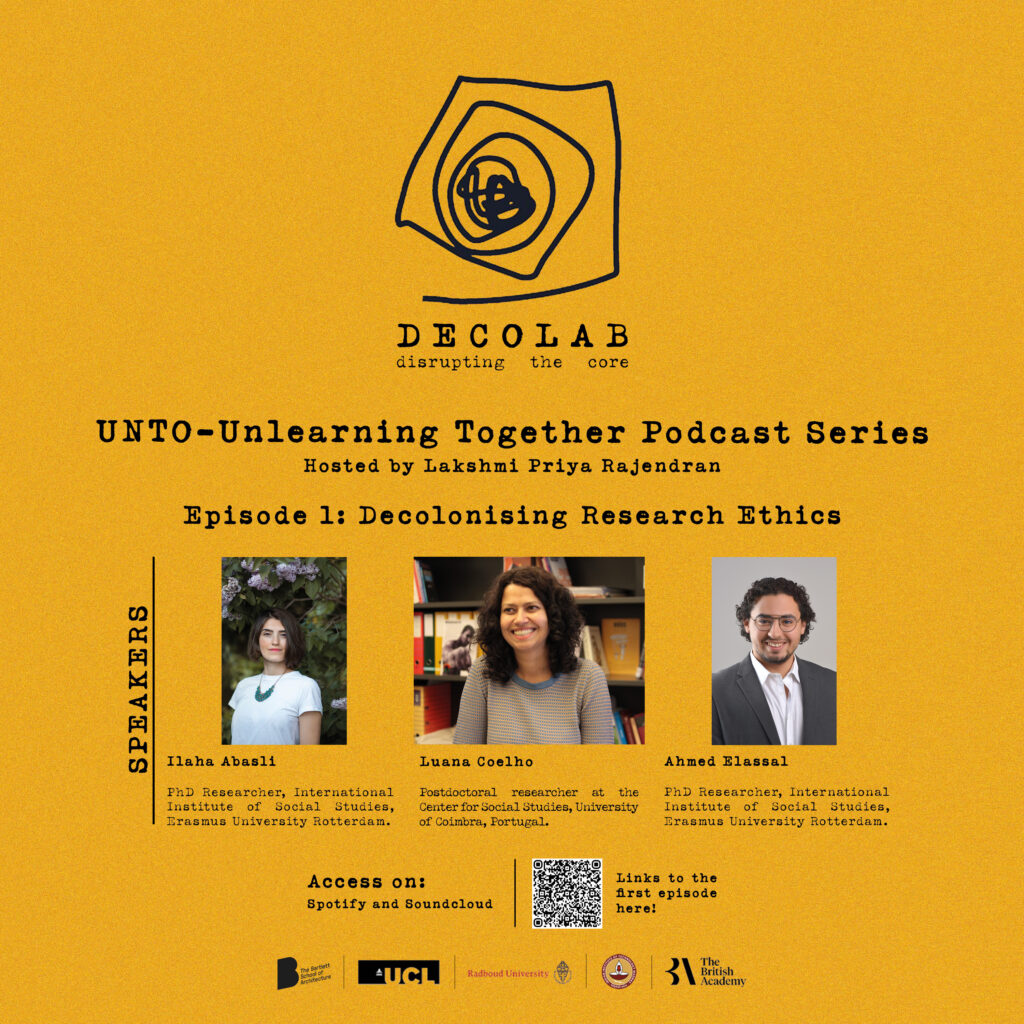
Episode 1: Decolonising Research Ethics
By questioning the dominant and hegemonic research paradigm in Western institutions, our first episode argues for a radical shift in understanding ‘what ethics is’ and the need for a disruptive language for research.
Recommended additional resources:
Chelwa, G. (2021). Does economics have an ‘Africa problem’? Economy and Society, 50(1), 78–99. https://doi.org/10.1080/03085147.2021.1841933
Crawford, G., Mai-Bornu, Z., & Landström, K. (2021). Decolonising knowledge production on Africa: Why it’s still necessary and what can be done. Journal of the British Academy, 9(s1), 21–46. https://doi.org/10.5871/jba/009s1.021
Fanon, F. (1963). The wretched of the earth. Retrieved from https://monoskop.org/images/6/6b/Fanon_Frantz_The_Wretched_of_the_Earth_1963.pdf
Giwa, A. (2015). Insider/outsider issues for development researchers from the Global South. Geography Compass, 9(4), 316–326. https://doi.org/10.1111/gec3.12219
Sarr, F. (n.d.). Knowledge on/in African societies. Retrieved from https://thecontrapuntal.com/knowledge-on-in-african-societies-felwine-sarr/
Smith, L. T. (1999). Decolonizing methodologies: Research and Indigenous peoples. London, UK; New York, NY; Dunedin, NZ: Zed Books; University of Otago Press.
Tilley, E., & Kalina, M. (2021). “My flight arrives at 5 am, can you pick me up?”: The gatekeeping burden of the African academic. Journal of African Cultural Studies, 33(4), 538–548. https://doi.org/10.1080/13696815.2021.1884972
Tuck, E. (2009). Suspending damage: A letter to communities. Harvard Educational Review, 79(3), 409–428. https://doi.org/10.17763/haer.79.3.n0016675661t3n15
Amarante, V., & Zurbrigg, J. (2022). The marginalization of Southern researchers in development. World Development Perspectives, 26, 100428. https://doi.org/10.1016/j.wdp.2022.100428