Transgressing “What is a Good City?”
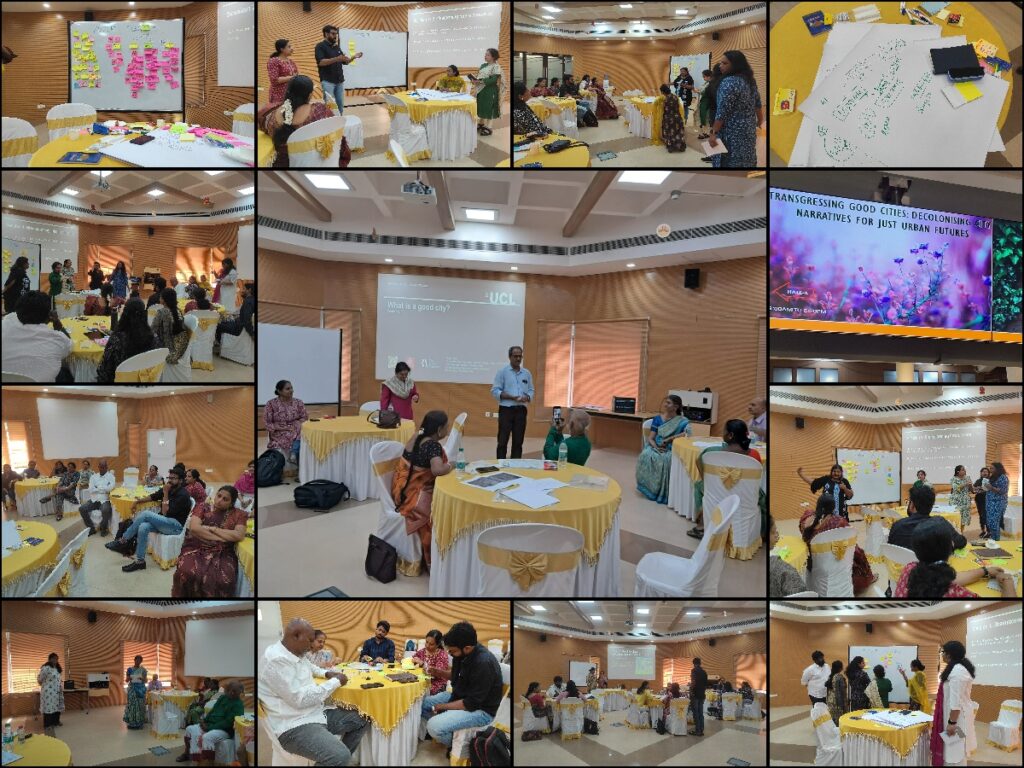
Funded by the British Academy’s Knowledge Frontiers: International Interdisciplinary Research 2022, this project investigates the impact of colonial legacies on people’s experiences and engagements with public spaces through a postcolonial city case study (Chennai) in India. By employing a decolonial lens, we aim to develop alternative city imaginaries rooted in residents’ place narratives, considering local heritage, culture, and values.
So, the questions that anchor our examination of the case study are:
How does Chennai borrow from and interrogate the colonial residues in the sphere of public space and everyday life?
How do the postcolonial urban spaces in the city define and/or reconstitute the social and environmental practices of people?
What does it mean to experience the city in the interstices of past and present, the West and India, Madras and Chennai, and what does such a possibility lead us to?
We conducted a series of participatory workshops with residents, community leaders and practitioners alongside other research activities to explore ways of co-creating alternative futures of public spaces in Thiruvallikeni, Chennai:
Workshop 1 involved residents and community leaders from Thiruvallikeni, one of Chennai’s oldest neighbourhoods. This workshop utilised storytelling and photovoice techniques to map out diverse perceptions of public spaces in a postcolonial context. Participants gained a deeper understanding of various viewpoints and were encouraged to continue discussions on the (de)colonisation of these areas.
Workshop 2 focused on exploring the colonial implications on the use, experience, and conceptualisation of public spaces. The aim was to develop a heightened awareness of how colonial legacies impact current practices and perceptions. This session fostered ongoing dialogue about decolonising public spaces.
Workshop 3 aimed to build a collective understanding of the transformations in public spaces during the postcolonial period, alongside the lingering colonial influences. This workshop helped participants develop a shared comprehension of these transformations and their impacts on public spaces.
Workshop 4 concentrated on constructing decolonial imaginaries for the future of public spaces. Engaging both experts and residents, the workshop aimed to create a vision for public spaces that supports justice and equity. Participants collaboratively developed ideas for decolonising public spaces and envisioning just cities.
Additionally, we conducted 30 individual narrative interviews to gather in-depth personal perspectives from residents about their experiences with public spaces. Two focus group interviews were held with residents, community leaders, experts, and practitioners to discuss collective and expert views on public spaces and their colonial implications.
We also undertook archival research, procuring secondary data such as published and unpublished materials—including documents, artworks, diaries, maps, and photographs—from sources like the Tamil Nadu State Archives, Urban History Documentation Archive, Connemara Public Library, Madras Museum, and Madras Literary Society (on-going project)
Team

Principal Investigator
Co-Investigator
Co-Investigator
Postdoctoral Researcher
Visiting Researcher

Research Assistant
International Advisory Board
Gurminder K Bhambra – Professor Postcolonial and Decolonial Studies, Department of International Relations Director of Research and Knowledge Exchange, School of Global Studies, University of Sussex
Dr. Pushpa Arabindoo – Associate Professor in Geography & Urban Design, Department of Geography University College London
A.R. Venkatachalapathy – Professor, Madras Institute of Development Studies
Prof. Sumathi Ramaswamy – James B. Duke Distinguished Professor of History, Duke University, Department of History, Durham
Prof. Sujata Patel – Retd. Professor, Kerstin Hesselgren Visiting Professor, University of Hyderabad, Umea University
Funders